

Watch Well Games #70
The Sutra of Pale Leaves Carcosa Manifest review. Also: What if all you had to do...was sing?



Welcome to our community newsletter!
Today we’ve got:
Cool Indie Corner returns.
CJ Weigel’s is halfway through his dungeon creating challenge for Advent.
A review by Wazza’s Whimsical Wanderings for Carcosa Manifest, one of Chaosium’s latest releases.
But first, what if all you had to do…was sing?
🤔What’s Up, K.J.?
I subscribe to the Substack newsletter Stat Significant by Daniel Parris. The most recent, “Do Music Stars Write Their Own Songs? A Statistical Analysis” is - as usual - fascinating, and it got me wondering if this same type of analysis could be applied to our hobby of ttRPGs. I think the results would be quite different, as most indie game creators design and write their own games and adventures, right?
While we don’t have the equivalent of a Max Martin songwriter-producer in our corner, we are, however, likely to out-source regarding areas where we lack knowledge, skills, talent, etc. A game designer may create mechanics and rules but not handle layout or art.
Or maybe financial or network constraints limit the individual creator, causing them to do all of the work regardless of their ability or inability.
Are you an indie game creator that handles all the work, or do you collaborate with others?
Do you learn things on the fly as needed to make your game material, or are you a highly skilled generalist who’s over the years learned to roll with the punches?
When I was involved in some performance groups in the past, I usually had a limited scope. I learned the song - then sang. Or danced. Or played the drums. Or the bass. At most, I sang while playing an instrument. But -
I didn’t do all of these at the same time, which I imagine may have looked like this:

Two and half years ago, I met a small goal I had set for myself - to finally publish some…thing on DriveThruRPG. I did so through its annual game jam PocketQuest. Things that summer got wild - and sadly, not in a good way (see “If Anything That Can Go Wrong, It Will” by Murphy’s Law). It came down to the final week, and I honestly wasn’t sure if I would be able to meet the deadline.
But I did. (And I know - this is part of a good story, where most folks tell you they went on to become renowned experts in their fields or win some award or something else spectacular. This is not that story.) I made a small game. I’m still a normal creator who makes things because it’s enjoyable.
What does this all mean for YOU?
Maybe you’re looking for fellow indie creators who have fairly normal lives and make stuff for our hobby because you enjoy it - you can and you will as nature intended. The catch? You’d like a bit of help in the areas where you’re not as skilled or have less knowledge. Perhaps you just don’t enjoy doing certain tasks that’s a part of making and publishing a game.
You’re not interested in being a one-pony band (yes, let’s stay with the GIF’s theme, shall we?).
In March of this year, I kicked off the Watch Well Games creators coalition - a small group of creatives that I saw have the potential to do more, together. (We did just release our very first zine The Quintessential Curios #1.)
The goal was and is to help connect folks to trade their skills with one another (free, barter, or even low-cost) and collaborate on their indie tabletop RPG projects. It's a small, cozy group where we focus on making ttrpg content and encourage one another in the process.
As 2025 wraps up, I've been pondering this year's journey as I continue to experiment with making ttrpg stuff and things. It's been interesting to see how things have unfolded, and I'm looking forward learning and growing more.
What about your own journey?
🔎Wanted

I’m looking for folks to chat with me about this (possible newsletter interview section content): Do you struggle with holiday blues? Does playing tabletop roleplay games during the cold, dark wintertime help you?
Message me or email kj [at] watchwellgames [dot] com if you’d like to be sent a short set of questions and share a positive story of how tabletop RPGs help folks like you (and me!) get through this season. Thanks!
💫Cool Indie Corner💫
A quick glance at some things in the tabletop RPG realm (and beyond this time) that piqued our interests recently:
Clayton Notestine of Explorer’s Design shares “3 gifts every game designer wants” - and I hope to take time during the rest of this month to respond properly to these practical calls to action. There’s more content in the newsletter, so please curl up with a hot beverage and a good read.
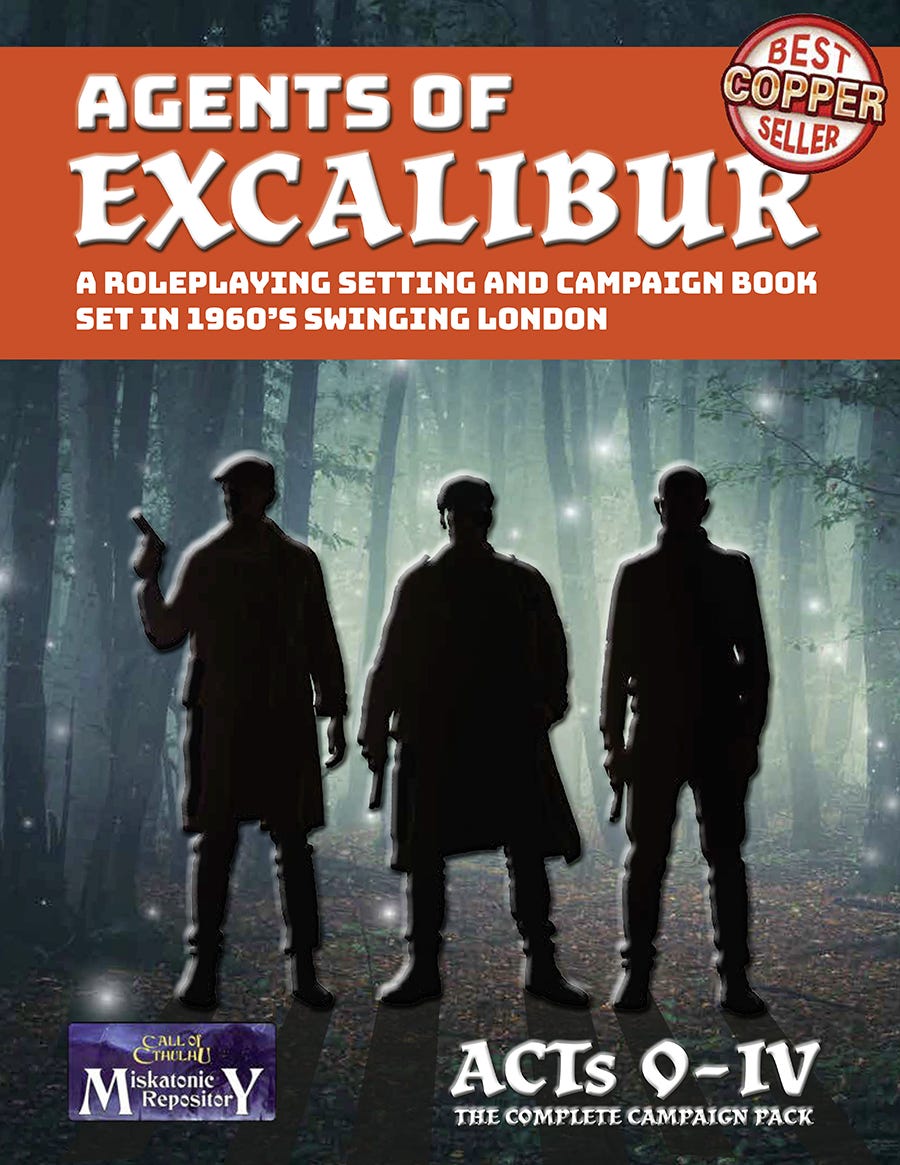
Agents of Excalibur: The Complete Campaign by Sam Vail and Paul Cockburn on the Miskatonic Repository recently caught my eye. You had me at “1960s Swinging London”, but hey, this looks like a lot of fun! It’s already a Copper bestseller on DriveThruRPG, so folks thus far seem to enjoy it.
⚔️ Advent(ure) Time - Continues!
One of Watch Well Games newly minted writers, CJ Weigel, began his Advent(ure) Challenge on Monday, December 1st. Creating something every single day in a row for several days is ambitious and…challenging.
Hence why we call these things a “challenge” I guess.
Follow CJ on Bluesky to see the latest updates.
Day 12 (today) is “Rattle the Bones”, and I’m eager to see what CJ creates!
ICYMI, here’s the original post:
Advent(ure) Challenge

Three days until the Advent(ure) Challenge kicks off! Each day for Advent, I’ll write a short dungeon or adventure that fits on a single 6x9 spread. No art, no system, only vibes. I came up with a fun little prompt calendar, and I’ll be making generous use of random generators (mostly Shadowdark).
How do you push yourself creatively? Does joining a group with like minded folks aiming for a similar goal help? Or does it make creating more stressful?
🎲 Review: The Sutra of Pale Leaves Carcosa Manifest
by Warren Davidson (Wazza)
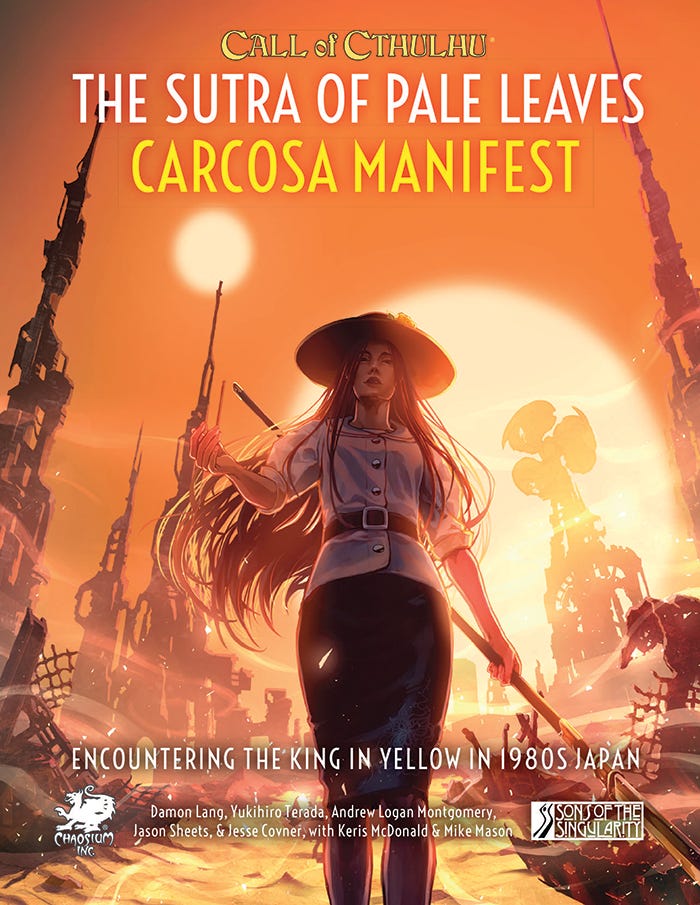
The Sutra of Pale Leaves Carcosa Manifest is a 194-page campaign for Call of Cthulhu set in 1980s Japan. It’s available in PDF for $21.99 and print for $42.99 from Chaosium who provided my review copy. It can be played on its own or combined with The Sutra of Pale Leaves Twin Suns Rising (reviewed in newsletter #69).
*****Spoilers ahead part two, players stop reading now. Keepers, you’ve come this far so keep reading!*****
As you’d expect from Chaosium they continue their phenomenal cover and interior art with a clear and presentable layout. Chapter One duplicates the information given Twin Suns Rising so I won’t repeat it here. Chapter Two contains four investigations which can be played independently or linked to form a campaign along with six pre-generated characters provided. So lets begin with…
The Bridge Maiden, Part One set in September 1987. The investigators are asked by Umezono Kaho, a young fashion designer to find her missing brother who has transformed into a monstrous adherent of the Prince of Pale Leaves. By using an artefact known as the Mandala of the Divine Eye the Association of Pale Leaves (the bad guys from Twin Suns Rising) discover Umezono is an ideal candidate to be the host for Hashihime, an ancient Bridge Maiden with the power to create a cross-dimensional link between Carcosa and Tokyo allowing the Prince of Pale Leaves to enter Japan. Talk about a bridge over troubled waters! Six plot hooks are provided along with NPCs. The adventure is set in the Harajuka area with investigators making extended use of the subway. They’ll begin by checking out the missing brother’s apartment and interviewing the building’s residents where clues lead to encounters with his parents and co-workers and finally into Tokyo’s Shinjuka district with a showdown in the Tamagama aqueduct. Additional encounters with a Yakuza boss to whom the brother is indebted and a film director add some colour. This can be played as a standalone scenario although It’s recommended to combine it with Bridge Maiden, Part Two. This one is fairly gentle on the investigators so don’t expect many casualties or SAN loss.
Wonderland is set in Spring or Summer 1988 where a teenage pupil has succumbed to the Sutra of Pale Leaves masquerading as a video game called Wonderland. This adventure plays like a twisted Alice in Wonderland with the Prince of Pale Leaves luring hapless victims into his Garden of Wonders - a parasitic pocket dimension to feed on them. It takes place in Kagaminuma, a neighborhood in Adachi City of greater Tokyo, and it’s recommended the Investigators play teachers from the Kagaminuma High School which the boy attends. A traumatic start in a school corridor leads the investigators down a perverse rabbit-hole of the Pale Prince’s creation. Exposure points can rack up here (see my review of Twin Suns Rising for details) and investigators can quickly lose themselves to the Pale Princes influence if they’re not careful. The school is described in-depth along with its teachers. Extra curricular investigations include the Adachi City Hall and general hospital, the boys home whose computer can be used to play and enter the Wonderland game itself. This is a great encounter playing like an actual video game from the late 1980s replete with screeching modems, MUDs and text-based adventure! This scenario can be rough on the investigators with a TPK a distinct possibility and caution is advised as this does includes references to visceral gore, school bullying, self-harm, and suicide.
Concluding the Bridge Maiden saga, Part Two takes place in October 1988 where the Bridge Maiden will bring the Prince of Pale Leaves into Tokyo! It’s recommended to run this one near the campaign end as a showdown with the Prince will be lethal for inexperienced investigators. Here the Sutra is infecting Japan’s youth through their obsession with fashion. By studying the Mandala of the Divine Eye recovered from Part One the investigators will encounter maddened mobs, attend a fashion house lunch party with an accompanying ritual to summon the Pale Prince, visit the Association of Pale Leaves cult headquarters and meet an old friend. The climax takes place on Tokyo Bridge where the investigators must prevent the Prince of Pale Leaves from making an unwelcome appearance on the catwalk. There’s several ways this can go with fighting the Prince a truly desperate option. This one really ramps up the stakes and can end with disaster where the investigators all go insane, die, or are consumed by the Prince.
We finish on the Fixer set in November 1990 with the investigators living as vagrants in Akihabara’s subway station. Freeform and sandbox in style, this will suit Keepers and players into improvisation and storytelling. As such this is not a required scenario of the campaign and can be played as a standalone. Starting at rock bottom the investigators’ reputations have been irrevocably damaged, their former lives stripped away, jobless, homeless, and penniless. It begins with a Good Samaritan offering them a new start from a mysterious benefactor known as the Fixer located in the heart of Akihabara Electric Town. The Fixer can restore their shattered lives in return for their help. He wants five morally reprehensible people humiliated and humbled. The twist? With each success the city and the Fixer begin to transform, becoming vessels for the Pale Prince. The five individuals, known as Strawmen, are intricately detailed with the investigators striving to discover their weaknesses, lifestyles, possible locations and how best to approach them. The outcome to all this is not predetermined, rather the investigators may come to realise their very actions are causing the city of Carcosa to manifest in Akihabara and can end with them turning on the Fixer.
In conclusion these adventures are imaginative, surreal and thought-provoking, and above all they succeed admirably in evoking the beauty which is Japan. This has my highest recommendation.
That’s a wrap! And remember:
Thanks for reading Watch Well Games. Newsletters are free and drop every 2nd and 4th Friday.