

Watch Well Games #71
Something amazing, I guess.



Welcome to our community newsletter!
Today we’ve got:
Whiskey, Blood and Dust answering my questions about how tabletop RPGs can help with the sad seasonal feelings a lot of us struggle with during this time of year in “When Wintertime Hits Hard: Tabletop RPGs and Seasonal Feelings.”
Wazza’s Whimsical Wanderings reviewing Sentience Core Rulebook.
And me kicking things off with asking: What tabletop RPG would you like a play-through report for in 2026 in “What’s Up, K.J.?”
🤔What’s Up, K.J.?
In some ways, 2025 didn’t go the way I planned it. I’m sure a lot of you can relate to that sentiment. Despite a few set-backs or just Life in General™, I had enough good things happen. I hope you did as well 🤍
One thing I didn’t do as much as I wanted to in 2025 was run as many games as I initially planned. But that changes now, as I’m actively making plans to return to the GM table so I can once again run games consistently.
YOU benefit from this, because I will be writing play-through reports and sharing them here. Maybe these will encourage you to run games. Perhaps they’ll shed light on a new-to-you game - you know, that one you’ve been eyeing from a distance for awhile.
I hope you’ll enjoy these reports. I know I’m excited! That said, let me know:
What tabletop RPG would you like a play-report for?
What tabletop RPG did you most enjoy in 2025?
What tabletop RPG are you looking forward to getting to your tabletop in 2026?
🌨️When Wintertime Hits Hard: Tabletop RPGs and Seasonal Feelings

Whiskey, Blood and Dust reached out to my call for folks to chat with me about whether playing tabletop roleplay games can help with the holiday blues during the cold, dark wintertime. 🌟Thank you for sharing, WBD, these thoughtful responses!🌟
When and how did you discover that playing tabletop RPGs was beneficial to you when facing the seasonal blues?
The winter blues, or Season Affective Disorder, or whatever you prefer calling it has always bothered me. Well, maybe not as a kid. Winter was about school cancellations, sledding, Christmas presents, and the like. Asan adult though, I really started to notice it.
There’s definitely science behind reduced sunlight and mental health. Circadian rhythms get out of balance, melatonin production suffers, vitamin D levels drop, etc. Not to mention overspending on holiday gifts and all the bills that come due at the first of the year.
I found that playing TTRPGs was excellent therapeutic tool about five years ago. In the summer and spring, I tend to be outside more and get much more exercise. That takes a hit when it gets cold – especially as I’ve gotten older. I still manage to keep a routine, but I need something else to help.
TTRPGs keep my mind engaged and my creativity stoked. They also reduce screen time which I’ve noticed never helps my mental state.
During this time, do you tend to play more solo RPGs, more group RPGs, or is it about equal?
In the late fall and winter I tend to play more solo games. It just seems more difficult to get a group together when everyone is traveling for the holidays or weather keeps people indoors. I’ve made an effort to reduce screen time so I typically don’t go involve myself in VTTs.
Solo gaming provides the answer. I can play on my own schedule and make the sessions as long or short as I want. The games also serve as a spring board for art, creative writing, and lead me towards books/movies I might not otherwise have discovered.
Or is it this variable perhaps the same as other times of the year? (i.e. You only play solo RPGs.)
I definitely play more solo games than group games these days year round. This is mostly because of scheduling because I very much enjoy the social interaction.
Also during this time of year, do you turn to familiar RPGs for comfort or a sense of nostalgia, or do you seek out new RPGs?
The season does really affect my choice of games. Though I prefer darker settings I do try to mix it up somewhat just so my mind isn’t constantly in a grimdark mode. Winter does provide a lot of inspiration for dark fantasy or horror though.
I don’t really think the season changes what I choose to play very much. Like most people I have my favorites, but I make an effort to try something new at least every other campaign.
What other encouragement, insight, or tips would you like to offer newsletter readers?
Everyone is unique in how they deal with winter blues, what games they play, and how they choose to play them. I think the key to beating the blues is to maintain some type of schedule and find ways to continue doing what makes you happy the rest of the year.
Modify activities as necessary. Can’t/won’t go to the gym? Then create a home workout to keep moving. Friends can’t get together to play? Use a VTT or play solo. Draw, paint, write, play instruments, or learn languages.
Do whatever it takes to keep your brain active.
🎲Review: Sentience Core Rulebook
by Warren Davidson (Wazza)
The essence of being human is that one does not seek perfection.
- George Orwell
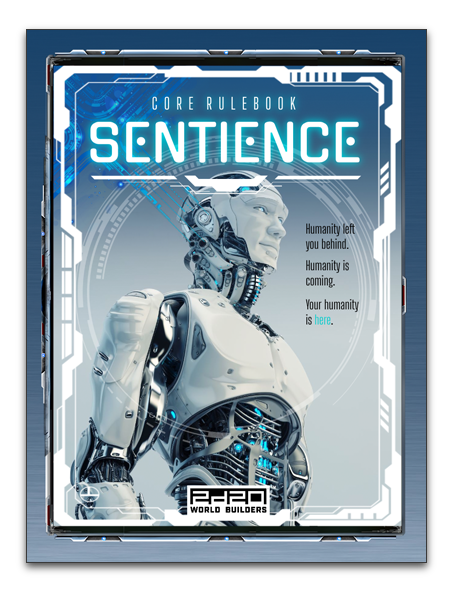
The Sentience Core Rulebook by The Yellow Hand, who kindly provided my review copy, is a welcome and refreshing change to how robots are typically depicted in movies and TTRPGs. Rather than mindless automatons or relentless killing machines, they have emotions, empathy, morality, and you get to play them! The game is available from DTRPG as a 220-page PDF for $14.99.
It’s easy to read with copious robot-inspired artwork throughout. We begin with a robotic history where humans have left our solar system and colonized the far reaches of space. To facilitate this they created an obedient workforce capable of performing the myriad tasks necessary to create habitable biomes. Unfortunately an undocumented catastrophe occurred and the colony ships were sent off course. One landed on Gliese 667 and the robots began the arduous task of terraforming the planet to make them suitable for human habitation. Jump forward 375 years and nearly two-thirds of the robots suddenly became self aware, a momentous event referred to as the awakening. Robots could finally think for themselves and create their own destiny while patiently awaiting humanity’s return. Despite their engineering excellence robots have subsequently been unable to recreate sentience in newly manufactured machines with many believing it was humanity’s departing gift. And that very sentience has brought with it its own problems as robots now feel the whole gamut of human emotions from love and pride to sadness at their departed creators. You are one such robot.
The world you know chapter covers robotic society and their beliefs, but rather than present a dry academic account there are liberal doses of humour laced into the narrative making for a fun read. especially when describing robots mimicking human behaviour! I suspect this was intended as a core component of the play experience from the very beginning, and one I applaud.
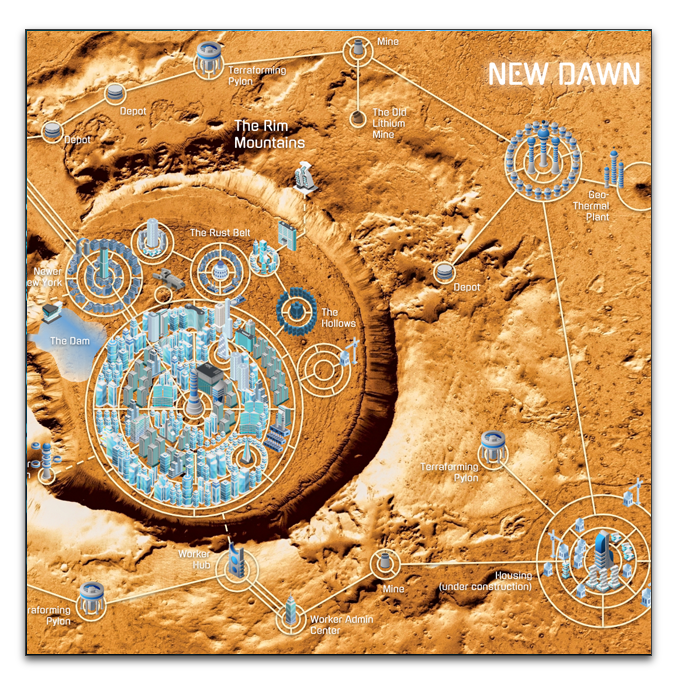
Once constructed robot cities are self-contained and surrounded by hostile environments so Robots rarely have the need (or desire) to go outside. Their society is decentralised with most existing in self-contained ecosystems. One such city, New Dawn is extensively detailed, representing a pristine example of what robots can achieve through hard work and diligence. There’s a fabulous two-page full color map of the city showing key locations which makes for a useful homebase from which to start a campaign. Several areas are extensively detailed with information on important places located within, NPCs to interact with, and narrative hooks to help form fully-fledged adventures.
Robot society is broken down in social groups such as the knowledge seeking Seekers, the robot building Architects, perfection seeking robotic transhumanists, the explorers who dare to venture outside the city, the custodians who are content with the menial tasks of running the city, the resourceful R&Ders, the often brutal enforcers, and the intellectual boundary breaking philosophers. As you can see they are an eclectic bunch guaranteed to scratch your group’s role-playing itch. This is followed by the importance of safety mechanisms in game with the likes of systems such as lines and veils, and the X-card discussed in detail.
The nuts and bolts of character creation involves a life path process to calculate values for your emotions, protocols, programs (choose up to six specializations), values (what you believe in), traits (your robotness), and talents of which there are forty-six to choose from each one providing a small intrinsic benefit to your robot. You start by choosing your role in robot society (Administrator, analyst, assembler, engineer, protector, or recycler) your reaction to the awakening (aggressiveness, confusion, curiosity, disengagement, engagement, or observation), your social group (education, family, public services, military, religion, or workforce) along with a couple of life defining moments. This means no two robots characters will ever be alike and this is the first time I’ve seen emotions depicted in a TTRPG, adding a level of verisimilitude to the concept of sentient machines. Advancement is through character points earned by learning, exploring emotions, and connecting with your fellow robots. The equipment chapter covers a multitude of weapons, cyber attacks, and upgrades which you can equip and bolt onto your robot.

The core game mechanics use the same system as Achtung! Cthulhu and Star Trek Adventures, add together the values for an Emotion and a Protocol giving a result between eight and seventeen then roll 2d20. Roll equal to or under this value for one success with natural 1s scoring two successes. 20s generate complications which the director will normally adjudicate. Additional d20s can be bought with momentum earned through gaining extra successes while threat is the directors equivalent to momentum and spent to make things more challenging for the PCs. The system has plenty of extras and is tried and tested.
Combat uses zones with rules for movement, cover, ranged, melee, and cyber attacks. Targets resist damage with armour with penetration causing drain and eventual defeat. Robots can take random system damage too. It’s quite lethal. Additionally there’s rules for chases, pursuits, and social conflict.
The chapter on directing the game covers playstyles, players needs and expectations, story elements, and emotions. NPCs have their own chapter covering their creation as well as numerous robots for the PCs to interact with. The book finishes up with a lengthy beginning adventure entitled Union Strike! Which introduces the game’s concepts and rules including combat and social encounters over three acts. In conclusion the Yellow Hand have written a thoughtful, considerate, and humorous approach to what a robotic society left to its own devices might achieve and aspire to. The ultimate question of whether that leads to discovering their humanity is left for the players to decide. Highly Recommended.
That’s a wrap! And remember:
Thanks for reading Watch Well Games. Newsletters are free and drop every 2nd and 4th Friday.
I most enjoyed running ALIEN this year, and am looking forward to running Traveller in the new one.
That Sentience review is fantastic! The idea of playing robots exploring their emotional awakening is sucha fresh take on sci-fi RPGs. The lifepath character creation system sounds incredibly deep, especially how emotions get mechanically integrated into gameplay instead of just being flavor text. I've been running story-heavy games for about a year now and the challenge is always finding systems that actualy support narrative choices at the mechanical level, so this looks promising.